

We tested 5 popular hair growth products on women over 45. The most expensive one came last.
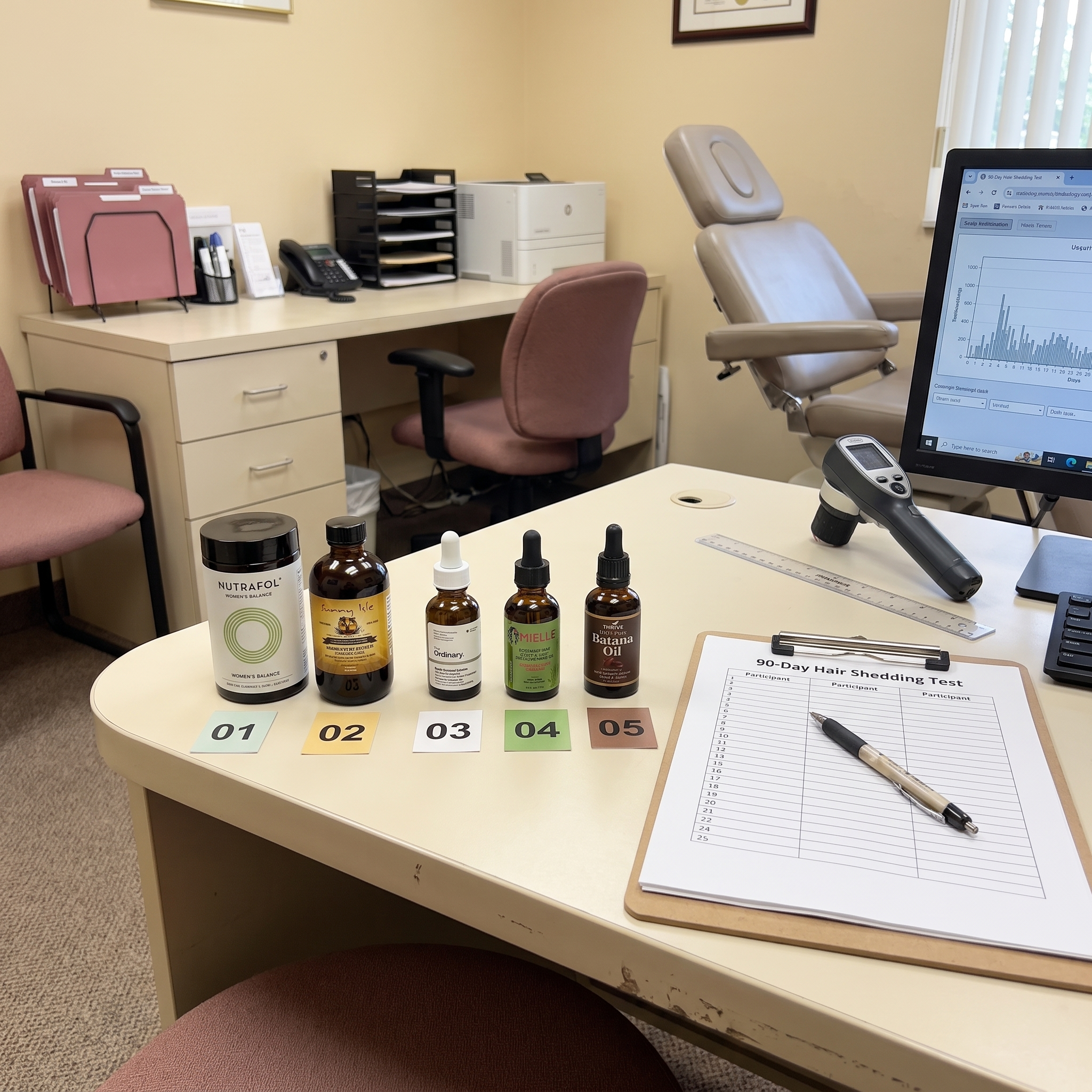
Ninety days. Twenty-two post-menopausal women. Every one had already failed at least one treatment.
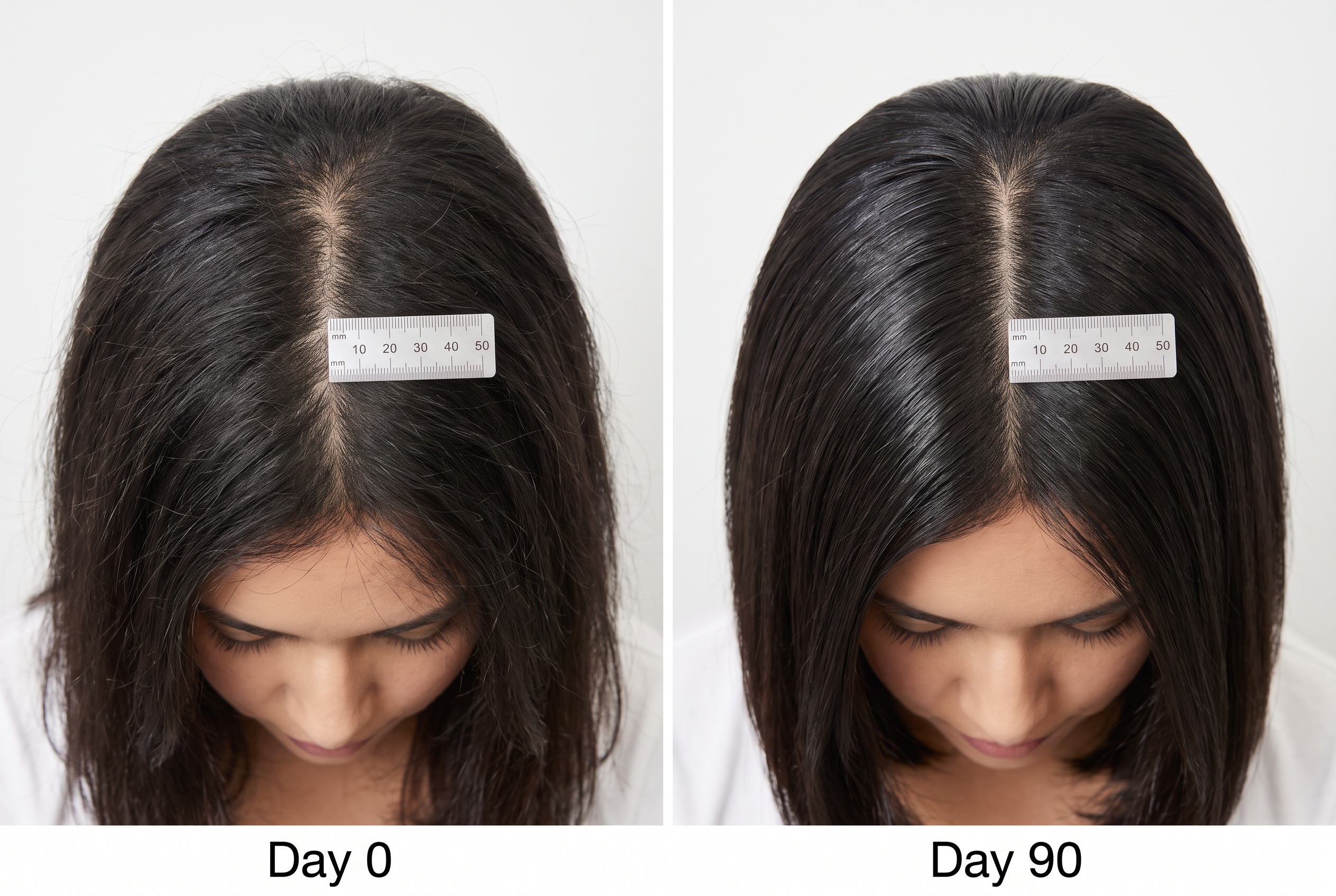
Same lighting. Same part. Same camera. Photographed at day 0, 30, 60 and 90.
The product almost everyone gets recommended finished fifth.
The one that finished first, I'd never stocked in twenty-four years of practice. I nearly left it out of the test.
Eleven of the twenty-two women were divorced. Nobody planned that. It changed what I thought I was measuring.
#3 is the reason nothing you've bought has worked yet. #1 is what I've used on my own head since.

I spent twenty-four years telling women there was nothing to be done
I have been looking at the tops of women's heads since 2002. I know the exact moment a consultation stops being about hair.
She's in the chair. I'm talking about density at the crown.
Then she says to the mirror, not to me: "I just look so much older than I feel."
Then she apologises for caring.
Women who have raised children, held jobs, survived the end of a marriage and rebuilt a life still apologise for minding that their hair is thinning.
It isn't vanity. We have the data now.
Not correlated with age. Correlated with how much hair she'd lost.
For most of my career I said versions of the same four sentences. It's hormones. It's age. Try minoxidil. There isn't much you can do.
Then I turned 51, eighteen months after my marriage ended, and I ran my hand through my own hair on a Tuesday morning and pulled out eleven strands. And I understood that I had spent two decades giving my clients accurate information and no help whatsoever.
Here's what actually happens after menopause, and almost nobody explains it properly.
Your scalp is skin. It ages like skin. Once oestrogen drops, the collagen underneath thins, blood flow to the follicle falls, and sebum production changes, which is why your hair went dry and wiry at the same time it went thin. The follicle isn't dying. The scalp stopped holding on to it.
That distinction matters more than anything else on this page, because it explains why the products in your bathroom cabinet haven't worked. Most of them were built for a problem you don't have.
A year ago, I stopped guessing and ran a test.
How we tested
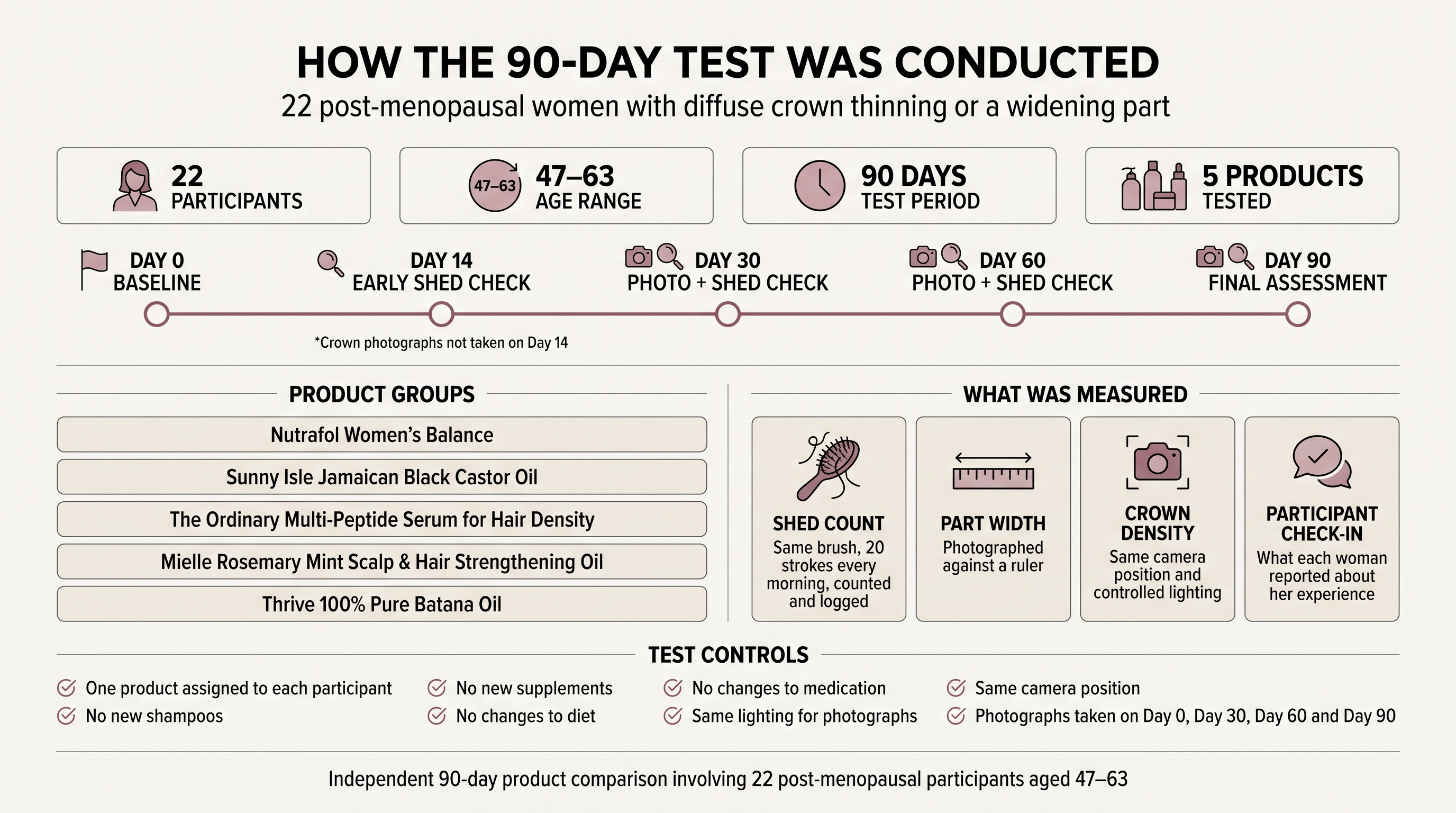
Twenty-two women from my practice, aged 47 to 63, all post-menopausal, all reporting diffuse thinning at the crown or a widening part. Every one had already tried and abandoned at least one treatment. Nine had tried minoxidil. Six had spent money on supplements. Four had been to a dermatologist and been told it was age.
Five products. Ninety days. One product each, nothing else changed, no new shampoos, no new supplements, no changes to diet or medication.
What we measured
- Shed count. Same brush, same twenty strokes, every morning, counted and logged. Unglamorous, and the most honest number in hair.
- Part width. Photographed against a ruler, same overhead light, day 0 / 30 / 60 / 90.
- Crown density. Same camera position, marked on the floor so it couldn't drift.
- What she said about herself. I added this almost as an afterthought. It ended up being the reason I changed what I stock.
The timeframe matters.
Ninety days is one hair cycle. It is long enough to see shedding change and usually too short to see regrowth.
In the best-known rosemary oil and minoxidil trial, neither group changed significantly at three months. Both only moved from baseline at six.
Shedding moves first. That is what we measured.
The verdict
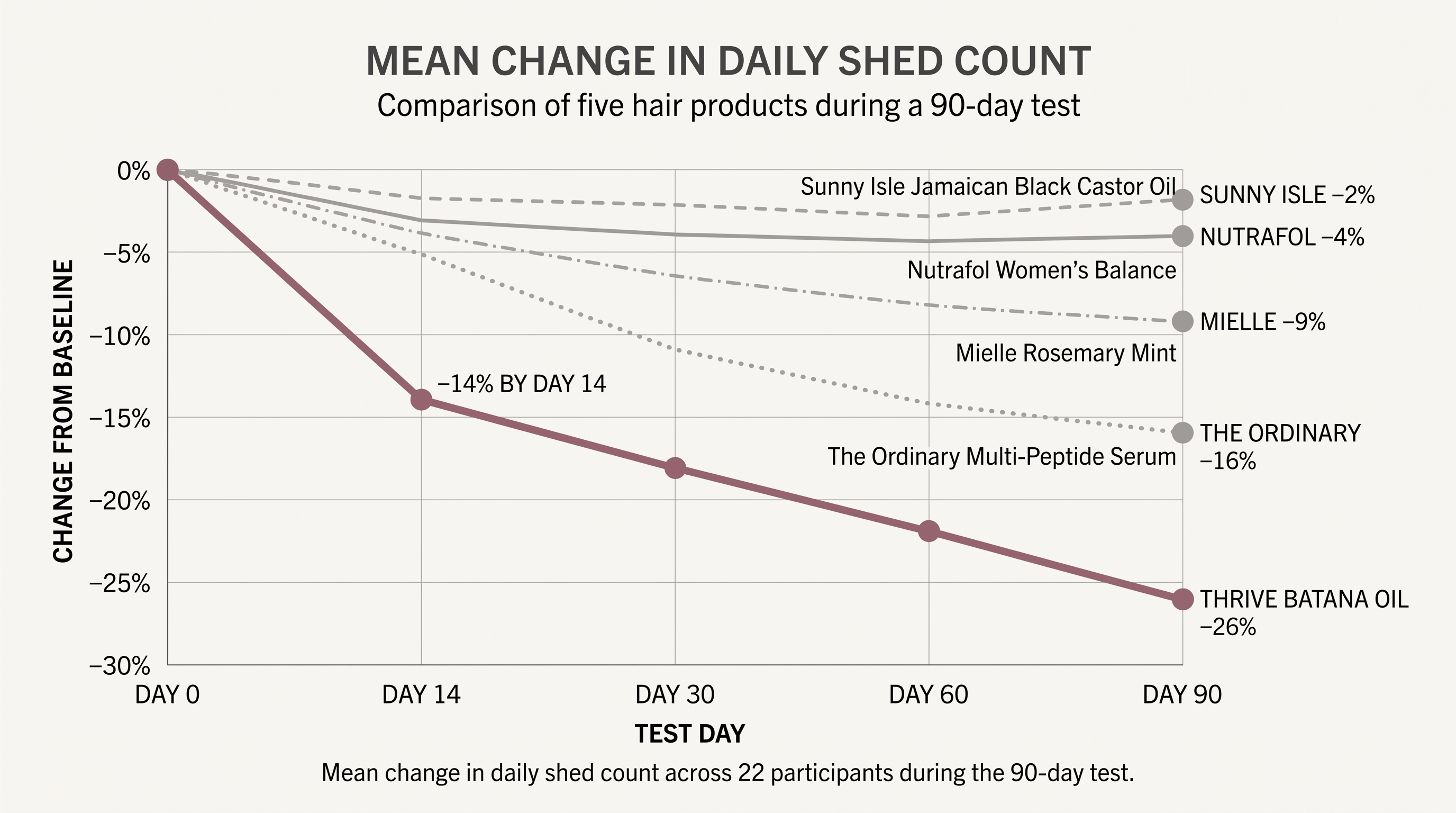
Every product below reduced shedding by some amount. What separated them wasn't how much. It was when.
22 participants · 90 days · one product each.
Nutrafol Women's Balance
What I expected
To be writing a very different article. This is the one my clients ask me about most, the one their friend swears by, the one the dermatologist mentions on the way out of the room. At $88 a month it's also the most expensive thing in this test by a wide margin.
What actually happened
I want to be honest about what that number means, because 4% sounds like something. It isn't. Your shed count varies by more than that between a Tuesday and a Thursday depending on when you last washed your hair. Four percent is inside the noise. If I hadn't been counting, nobody in that group would have noticed a change, and none of them did.
What they did notice: two reported stronger nails, one said her skin was better, one felt no different at all.
If your thinning is driven by a genuine deficiency, such as low ferritin, low vitamin D or an underactive thyroid, treating it systemically makes sense. Get bloodwork before spending more on anything topical.
A capsule has to be digested, absorbed and distributed through your entire body before a fraction reaches the scalp. You are asking a nutrient to run a marathon to arrive at a door that is half shut.
One of the four had been taking it for fourteen months. She said: "I don't know if it's doing anything. I'm scared to stop and find out."
That isn't a treatment. That's a hostage situation, and she'd been in it since the month her divorce came through.
So if the answer isn't systemic, if it has to go directly onto the scalp, then surely the oil every woman's grandmother swore by should have won.
Sunny Isle Jamaican Black Castor Oil
What I expected
The most enthusiasm going in. Cheap, traditional, decades of word of mouth, and the most committed group in the whole test, these four applied it more diligently than anyone.
What actually happened
Their hair looked better. Genuinely. Glossier, thicker to the touch, easier to style. Two of them said their hairdresser commented.
Castor oil is a large, viscous molecule. On your scalp, it coats. It conditions the shaft and makes existing hair feel thicker.
But the follicle sits beneath the skin. To reach it, an oil has to cross the outer layer of the scalp, and a molecule that size doesn't. Several women were also washing more often because their roots felt greasy, which brings its own problems.
Here's the uncomfortable part. Because your hair looks better, you keep using it. For months. While the shedding continues underneath, unchanged and unmeasured.
One woman in this group put it more precisely than I could have. She said her hair looked lovely in the mirror at eye level, and she still wouldn't let anyone photograph her from behind.
Shine is not growth. If the oil can't get in, nothing else matters, so the next question was whether a proper clinical active would do better.
The Ordinary Multi-Peptide Serum
What I expected
My professional favourite going in. Serious peptide complexes, published ingredient research, honest pricing, no marketing nonsense. On paper, the most scientifically credible product on the table.
What actually happened
The best result of the four losers, and I want to give it its due. 16% is a real change. Two of the four could see it in the plughole without being told.
But two also quietly stopped applying it properly by around week six. The common complaint: it dried within a minute and left a slight tackiness on the scalp.
A water-based serum lands on your scalp and mostly evaporates. What remains still has to cross the outer barrier of your skin.
A peptide with no lipid carrier is a brilliant passenger with no vehicle. It sits on the tarmac.
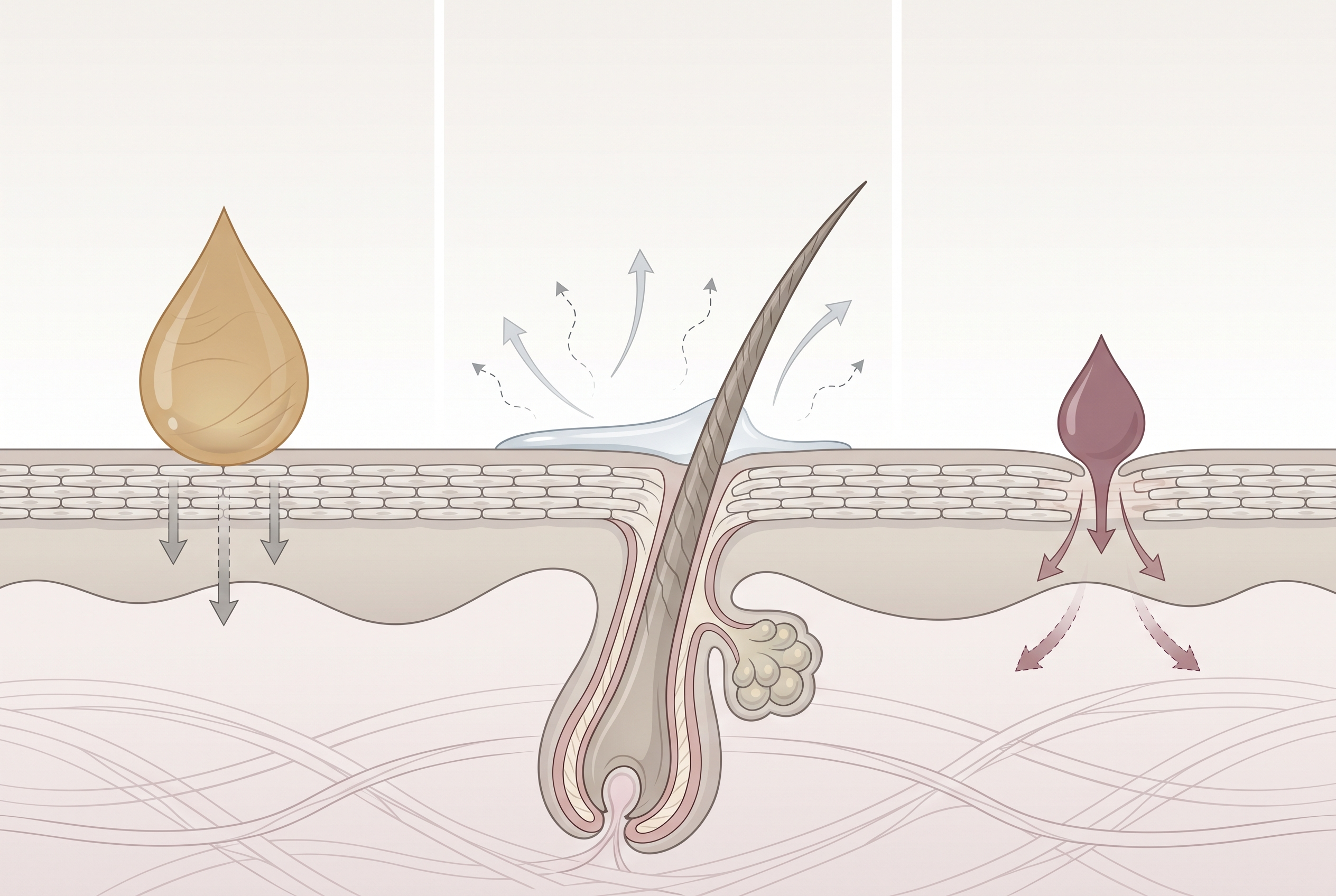
Sixteen percent is what happens when excellent ingredients get partial delivery. It's not a bad product. It's a good product with a transport problem, and you're the one who paid for the gap, over and over, and concluded the problem was you.
Which raised the obvious question about the fourth product. Rosemary genuinely does have evidence behind it. So why did it come in below The Ordinary?
Mielle Rosemary Mint Hair Oil
What I expected
Rosemary oil is one of the very few botanicals in this category with a real published record, and I expected this to place second at worst.
In 2015, researchers compared rosemary oil with minoxidil 2% for six months in 100 people with androgenetic alopecia (Panahi et al., Skinmed). At six months, both groups had significantly more hair than at baseline, with no significant difference between them.
Two things that never make it into the Instagram version.
At three months, neither group had changed significantly at all, the result only appeared at six. And every participant was male.
It was a small study in men, but it remains the strongest evidence for a botanical in this category.
What actually happened
Below the peptide serum, and below what the research would predict. The women liked using it, the mint tingle makes it feel like something is happening, and compliance was the highest in the test. But two reported heavy roots by day three and went back to washing every other day, rinsing the product out almost as fast as they applied it.
Read the ingredient list on any rosemary hair oil in a chemist. Rosemary usually sits near the bottom, below the silicones, below the fragrance, below the mineral or soybean base. It is present at a level that scents the product and earns it the name on the front. That is a very different thing from the concentration used in a trial.
Then there's the base it's suspended in. A conditioning base is engineered to coat the shaft. Same problem as the castor oil, one shelf along.
So these women were not wrong to believe in rosemary. They were right about the ingredient and got a version of it that was mostly conditioner wearing a rosemary label.
The part of this I didn't plan to write
Every thirty days, each woman came in to be photographed.
The camera work took four minutes. The conversations took an hour.
Eleven of the twenty-two were divorced or separated. I had not selected for that.
They said versions of the same thing, over and over.
"He saw me go grey. He saw all of it happen slowly. A new person would just see, this."
"I've had the app downloaded for seven months. I haven't put a photo up. Every recent one is taken from above."
"My daughter took a picture of me at her graduation and I asked her to delete it. She thought I was joking."
"I'm not asking to look thirty. I'd just like to look like me."
One woman had a list: lose a stone, sort her hair, then start dating.
She had been working through it for two years and had not reached the second item.
It puts your life on a waiting list.
You stop being in photographs. You stop swimming. You choose softer lighting.
You tell yourself you will start living after the hair is sorted. After you look like yourself again. After you are ready.
So here is the part I wish someone had said to me at 51, and it is the opposite of what this kind of article usually says.
The women who did best in this test were not the ones with the best hair at day 90. They were the ones who stopped waiting for permission somewhere around week two to three, when the shedding slowed enough that they weren't checking the drain every morning, and the mental space that had been going into it came back.
That is what actually changes first. Not the moment your hair is perfect. The moment it stops taking up all the room in your head.
Which brings me to the product that got there fastest. The one I'd never stocked, and nearly didn't include.
Thrive 100% Pure Batana Oil
Why it was nearly not in this test
I'll own my bias. Batana arrived in my inbox the way a dozen miracle botanicals do every year, a great deal of noise about a rainforest and very little about chemistry. I put it in as a control. I expected fourth.
What actually happened
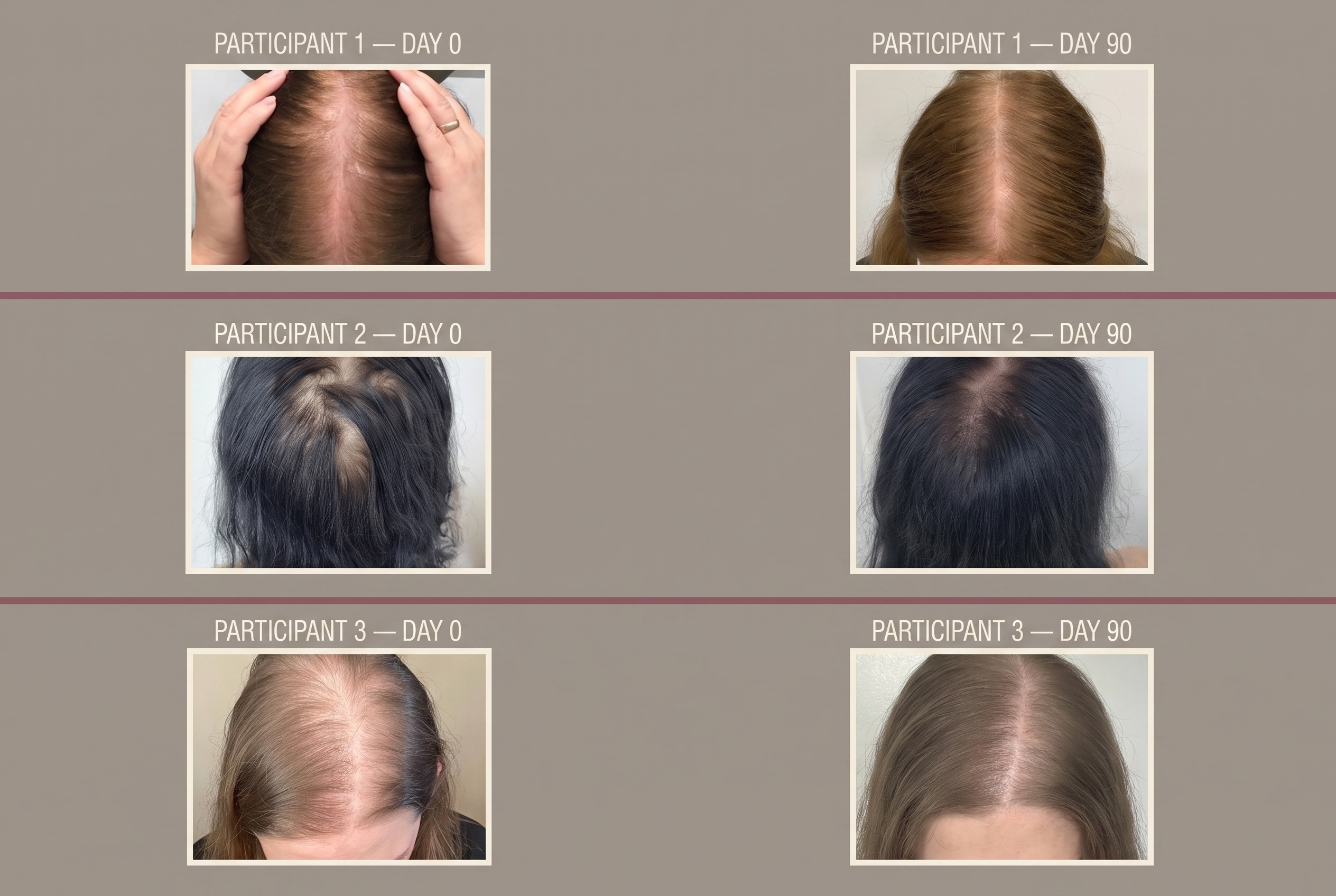
I want to sit on that number for a moment, because on its own it doesn't look dramatic. It's the date that matters.
At two weeks, nothing else in this test had moved.
This group was down 14% at two weeks. Three women noticed before I showed them the count.
By day 90: −26%.
Why it won
Two things had to be true at once.
It's a lipid the scalp recognises
Batana oil is roughly 45–55% oleic acid, with a fatty-acid profile close to the sebum your own scalp produces. That's the door I described in section three, skin lets lipids through, and this is a lipid built like the one your scalp already makes.
It goes in rather than sitting on top. Every woman in this group reported it absorbed within minutes, and not one reported greasy roots, the complaint that undermined both the castor oil and the Mielle. That is the whole difference between a treatment and a coating, and I think it's most of the reason for the speed.
It carries the rosemary in
This is the part I find genuinely clever, and it's why the Mielle section matters. Thrive puts rosemary into a batana base, the one botanical with real trial evidence behind it, riding in a lipid that reaches the scalp, instead of a conditioning base that doesn't.
Mielle had the right active in the wrong vehicle. The Ordinary had a good vehicle problem with better actives. This is the combination each of them had half of.
One thing I won't tell you.
You'll see batana sold as a "natural DHT blocker." I'm not going to repeat that, because I went looking for the evidence and there isn't a controlled trial on batana oil and DHT. There isn't a controlled trial on batana oil and hair growth at all yet. What exists is component-level research on oleic acid and tocotrienols, centuries of traditional use by the Miskito people of Honduras, a very large volume of anecdote, and now this test.
I'd rather tell you that than lose you when you go and check. What I can tell you is what twenty-two women's shed counts did over ninety days, and which product moved first by a distance.
What to check before you buy any batana oil
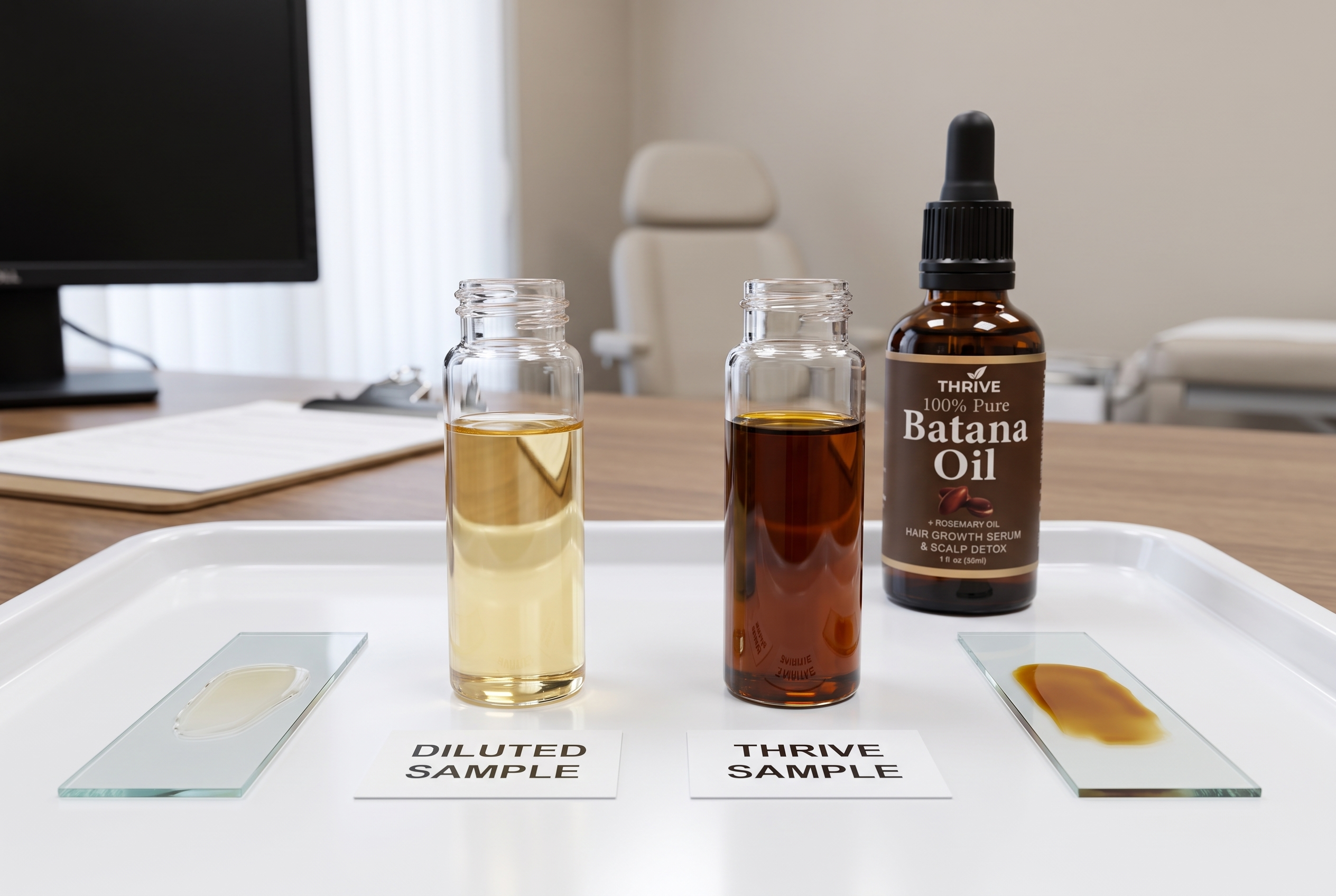
Batana is having a moment, which means most of what's sold under the name isn't what it says. In my experience the bottles fall into three groups: genuinely pure batana oil, oil cut 70–90% with cheap carriers like soybean or mineral oil, and product that's essentially fragranced base oil with a photograph of a nut on the label.
You can't tell from the front. Here's what I check now:
- The speciesIt should say Elaeis oleifera, the American oil palm, from Honduras. Elaeis guineensis is African palm oil. Different plant, different fatty-acid profile, a fraction of the price, and it appears on more labels than it should.
- Position in the ingredients listBatana should be first. If soybean, mineral oil or fractionated coconut sits above it, that's mostly what you're buying.
- Colour and smellPure batana is dark, deep amber to near-black, and smells nutty and slightly smoky from the traditional roasting. Pale and odourless means refined, diluted, or both.
- Third-party testingThird-party tested.
What the women said
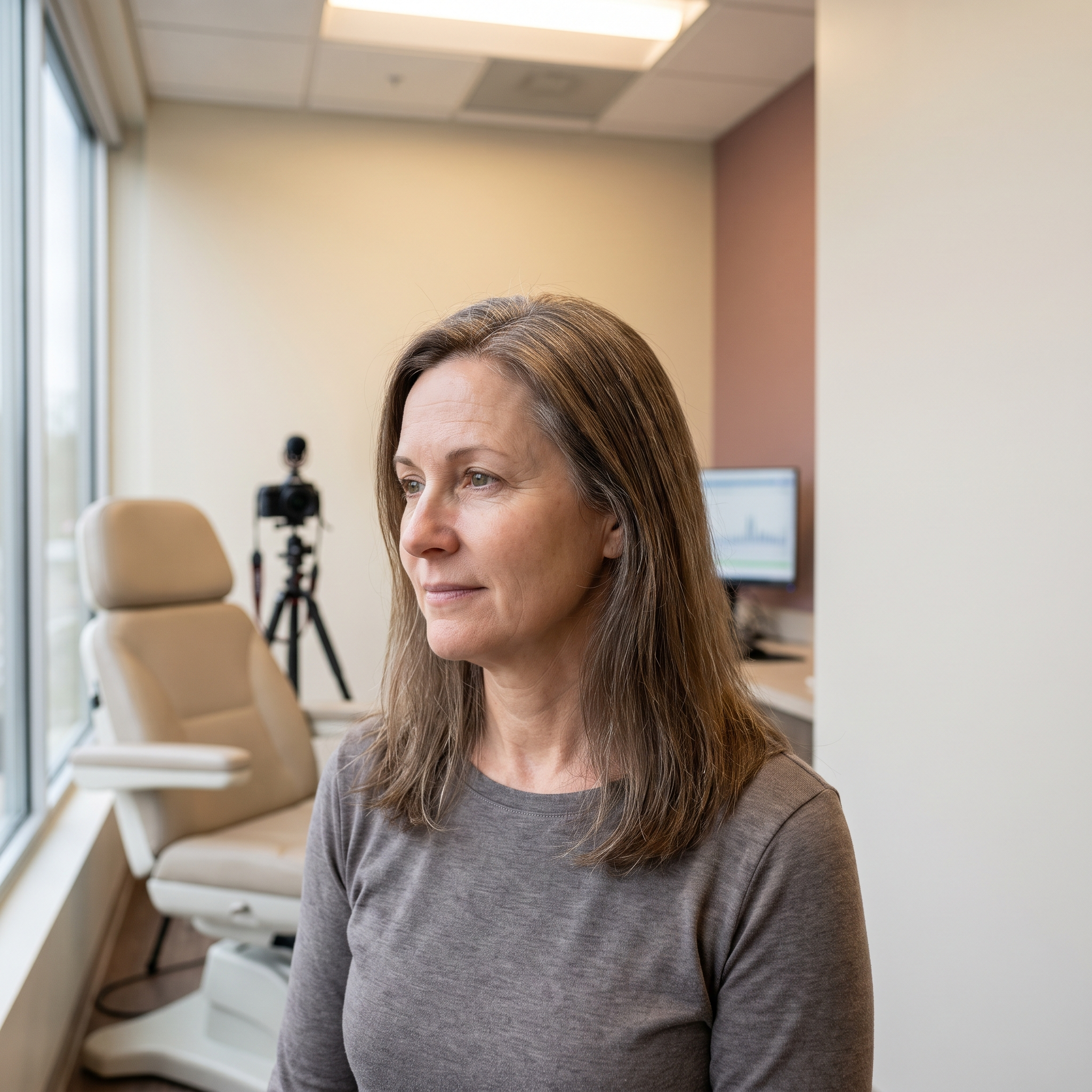
"I'd stopped wearing it down about two years ago. I had one parting that worked and I didn't deviate from it. I'm twelve weeks in and last week I dried it without thinking about where the part was going. That's the bit I didn't expect, not the hair, the not-thinking."

"I did the supplements for a year. Then I did PRP, which was £400 a session and I had four. I was extremely sceptical about a bottle of oil, and I'll be honest, I bought it to prove a point to my sister. The shedding slowed in the first fortnight. I'm still slightly annoyed about it."

"My hair goes flat if I look at it wrong, so an oil was the last thing I was going to try. It absorbs in about two minutes. I do it before bed, I wash as normal, and my roots are no different. I'd have started six months earlier if someone had told me that."

"My son got engaged in March. There are forty photos from that day and I'm in most of them. I didn't check any of them afterwards. I've thought about that more than I've thought about my hair."
The 90-day guarantee
Ninety days isn't arbitrary. It's one full hair cycle, the minimum honest window in which you can judge whether something is working, and the length of the test above.
Try it consistently for 90 days. If it is not right for you, contact us under the 90-day guarantee.
Questions I get asked
How long before I see anything?
Shedding changes first, and it's the only thing worth watching early. Count what comes out in twenty brush strokes tomorrow morning and write it down, that's your baseline, and it costs nothing.
In this test the batana group moved at two weeks. Regrowth is slower and you're waiting on the hair cycle for it, so give it the full ninety days before you judge. Everyone who quit anything in this test quit before week six.
Will it make my hair greasy?
Start with a small amount and massage it into the scalp at night. Use less if your roots feel heavy, then wash as normal.
Do I have to use it forever?
No, and I'll say that clearly, because fear of lifetime dependency is the single biggest reason women in my practice refuse minoxidil, and they're not being irrational. With minoxidil, hair loss typically resumes within three to six months of stopping.
There is no fixed lifetime requirement. Use it consistently for the first 90 days, then judge your routine by your own results.
Does it work on grey or colour-treated hair?
Yes, but use a small amount and patch test first. On very light or white hair, apply carefully at night and wash as normal to reduce the chance of transfer.
Can I use it alongside minoxidil, HRT or my supplements?
Check with your own doctor before combining treatments. Do not stop or change minoxidil, HRT or any prescribed treatment without medical advice.
What if it doesn't work for me?
You are covered by the 90-day guarantee.
The scalp is the target
Nothing you've tried has failed because you did not try hard enough.
Most products were built for a different problem: conditioners sold as treatments, actives with no way in, and capsules aimed at the bloodstream.
The scalp is the target. It has to be something that gets in.
And the list, lose the weight, sort the hair, then start, I would put that down. Ninety days is short. You have already given this years.